Monday, March 25, 2013

Mobile Money Concentrated but Powerful


Mobile Money has not caught on everywhere, and it needs the right nurturing to work, but where it has taken off it has made a huge impact in the following countries:

Countries with high % of GDP in Mobile Money Systems
Country
% of GDP in Mobile Money Systems
Kenya
>60%
Tanzania
>30%
Uganda
>20%
Côte d’Ivoire, Madagascar, Paraguay, Rwanda, Tonga, and Zimbabwe
2% to 5%
Source: GSMA

A recent GSMA report, http://www.gsma.com/mobilefordevelopment/wp-content/uploads/2013/02/MMU_State_of_industry.pdf  highlights this and shows how operators and third parties have been successful in developing mobile money systems.

To add more emphatic details as to the importance of mobile money, in Kenya, Madagascar, Tanzania, and Uganda, the total number of registered mobile money accounts in June 2012 was higher than the number of commercial bank accounts estimated by the IMF in their 2011 Financial Access Survey.

MMU announces the results from the 2012 Global Mobile Money Adoption Survey 

The question has always been can this type of service work in developed countries and the mobile money success in developing countries offers some clues. 
  • The majority of mobile money players are carriers
  • It is a business which is:
    • Very Op-Ex oriented
    • Needs to be a separate business outside of main telecom business
    • Needs blessing and support of the CEO
    • Requires a large number of agents and to have strict control of this distribution network
    • Works best when focused on one or two service at introduction
    • Requires getting people from registration to activation quickly
    • A human capital intensive business
    • Not dependent on current market share or competition 
    • Not a sure bet, some do well and some do not 

  • Benefits to consumer can vary by region (Savings, Bill Payment, etc.) (It is important to key into the local market needs)
  • There has to be a clear need by the consumer for this service and laser focus by the company to satisfy this need.

 A couple of ideas for developed markets come to mind like:
  • Making electronic payments as accepted as cash but with the ability to transmit to anyone.
  • Storing all important financial information in one place as mobile wallets are trying to do today
  • Having a place that records all of your transaction and helps a person save money. 


Wednesday, February 27, 2013

Google Needs Retail


Andy Rubinstein in a recent article with AllThingsDigital  was quoted as saying, “They don’t have to go in the store and feel it anymore,” during a roundtable with reporters at Mobile World Congress on Tuesday.


Well sort of, for devices people already know, like phones, but there are plenty of other good reasons to have retail stores:

  1. Mind share competition with Apple:  Letting people know that Android brand is the engine for many popular devices.  Especially in the US where Apple is strongest.
  2. The tussle for Tablet mind share requires more outward reach:  With the many number of tablets like Amazon Kindle, iPad, and Microsoft Surface creating competition.  Tablets will be a key battleground for search and tablet’s success has been one of the reasons that Google has raised its mobile ad prices.  Stores will not be about smartphones it will be about tablets.
  3. An opportunity to interface with customer to improve Google products, and get problems fixed for people who are not that comfortable with technology.  This is a growing trend as older people use technology. 
  4. Promote their own home grown products: Google Glasses and Google TV.
  5. Provide a sales channel for its carrier services like Google Fiber.  And provide retail lessons learned as they expand their carrier presence.
  6. A way to showcase Google future products like the un- manned car. 

How technology is handed to you, and how a company helps people understand technology makes all the 
difference.


.

The one thing that Google is missing is the hand to hand touch. Apple has it and it increased its value, Google finally needs it.

Wednesday, February 20, 2013

Interactive Experience Via WiFi


iSIGN (www.isignmedia.com) is a company that provides alerts to customers or fans that have a smartphone and are within WiFi range (300 ft) and/or Bluetooth range.  The alerts can be offers, greetings or messages with links that allows the user to interact with the store or venue.  The system also remembers the user’s phone and can send alerts when they return like “Welcome Back” or provide offers that are tied to user information.


The service in essence provides an interactive experience at a store or venue.  It has been used successfully at Mardi Gras World, the Host Committee Media Party for Super Bowl XLVII to provide offers to guests with interactive information about the event and 45 local restaurants. In addition, iSIGN also announced the installation of 500 Smart Antennas being installed into National Oil & Gas’ network of gas stations and convenience stores in Canada. The company also has installations in malls, stadiums and theaters in Canada.  

One of the sticky features of the service is that the offer will reside on the phones media or picture file so the user can act on the offer later.

A service like this has to be used judiciously because too many offers can be annoying and a pain to remove from the picture file, but people are not going to mind getting a greeting along with an offer for a desired item.  The offers can be used outside the store to bring people in or in the store to greet people.

Wednesday, August 1, 2012

Apple’s Mobile Payment Pieces are in Place

Apple acquired mobile security firm AuthenTec for $356 Million last week. AuthenTec offers a fingerprint recognition technology which works with the swipe of the screen. This will allow Apple to move forward in the mobile payment space in a big way. Apple can build an ecosystem around retail shopping the way they did with the app store. In addition this mobile payment service can ramp up very quickly using stored credit card information on iTunes. Apple can put a complete and workable mobile payment system in place for the following reasons:
  • Doing a swipe allows the shopper to make payments over the Internet (like PayPal) rather than use a tap solution (This avoids the availability issue of tap solution POS terminals)
  • Fingerprinting is going to make the shopper easy to authenticate, no pin numbers to punch in.
  • Fingerprinting is going to make the shopper feel more secure (One of the main concerns of shopper with mobile payment systems.)
  • This will be a software based solution so that it will work on all older iPhones with a software upgrade.  
This kills four birds with one stone.
 
In addition:
  • If this is the way people pay, then they will also likely use the Apple Wallet called Passport. 
  • Apple will gain additional payment information which will allow them to offer more targeted ads and promotions.  
Apple will not release a product unless they believe it is beneficial to iPhone users. Some of the potential advantages to shoppers include:
  • Avoiding lines if shopping for a few items and/or if users want to input store items using the phone barcode reader  
  • Storing all card information in one place 
  • Not having to carry a wallet
  • Storing coupons all in one place 
  • Getting better deals with Passport.
 
Apple has a history of putting together various technologies to create a service and customer experience that is a game changer, and all the pieces are in place to do this for mobile payments. However, this cannot be a Beta solution like Siri, one of the reasons they have waited patiently for the right time to roll out.

Thursday, June 14, 2012

360 Fun


For those people interested in making cool 360 videos check out GoPano, http://www.gopano.com/ . The GoPano gadget is essentially a mirror that takes video on a circle to allow for a 360 picture. The more pixels the camera has, the better the clarity on the video. The gadget can attach to a camera or an iphone 4.


It works better with the iPhone 4s than the 4 because the 4s has more pixel density. The product should also benefit from the expected popularity of the iPhone 5. The 360 video has a number of use cases because it is truly interactive video. Included is an example: www.gopano.com/video/5232.


The user has to react to move around the video and get a different view. It can be used potentially in a number ways:


• In commercials where Easter eggs or other promotions can be found

• In a video story or game were the user can go in a different plot line or area depending on the direction  the user moves around the video.

• To view sports on TV or in the stadium from a different view.  A certain player or area of the field can be focused on.  In addtion, it can create video replays from any angle for a referee.

• To view bands or other types of live entertainment where the user can focus on any place or performer on the video.

The really great aspect of this gadget is that it costs $80 so it is very affordable. People and businesses can experiment on how to best use this type of video for fun or to promote a brand or both. A number of consumer product brands have purchased and given out to product managers and marketing executives to try out and come up with ideas.

Sunday, April 29, 2012

Meeting People with Common Interests

Interact is a geo social application which is designed to do just that, interact based on location. To participate with the application the user needs the latest version of the iPhone Facebook application and to allow the application to link with Facebook.   The application uses your Facebook information such as connections and likes to determine mutual connections and interests between people.


The application is designed for people to meet other people who are in close proximity and have common interests. The screen shows all of the people who have common interests by rank within a given location. The radius of the person can be determined by a dimmer like switch which goes from a radius of 25 feet to the entire universe of most compatible users. The pictures of the people are large enough to that you get a clear idea of who they are. The app has the feel of who can I talk to today, and gives the user the opportunity to open up a SMS chat conversation. In addition the user can filter based on the type of interaction they want: any, dating, social or professional.

Interact is good for meeting people in social situations. Some people have mentioned that it can be good for remembering people names if you see them in a particular location. One drawback in creating an audience is the lack of Android support which encompasses a huge demographic who would find this application useful. Android support will be needed to give this application its full potential.

The other potential use case for this application is business situations and the company is planning to offer LinkedIn support. Right now growth in the application is via word of mouth. The app might not be for everyone.  To make the application more privacy friendly the  app designer interviewed women who are more particular in types of interactions they have and in displaying location. One of the incorporated feedbacks was to not include a map, which is a nice feature and allows for a degree of anonymity.

If you want to find out more about the thoughts on building a mobile geo social application by the founder Anthony Combs, it can be found at http://www.geosocialradar.com/blog/84/a-guide-to-building-location-based-social-networks-philly-tech-week.html.  Try out the app you may meet someone that you enjoy interacting with.

Sunday, April 8, 2012

Enjoy Your Time App

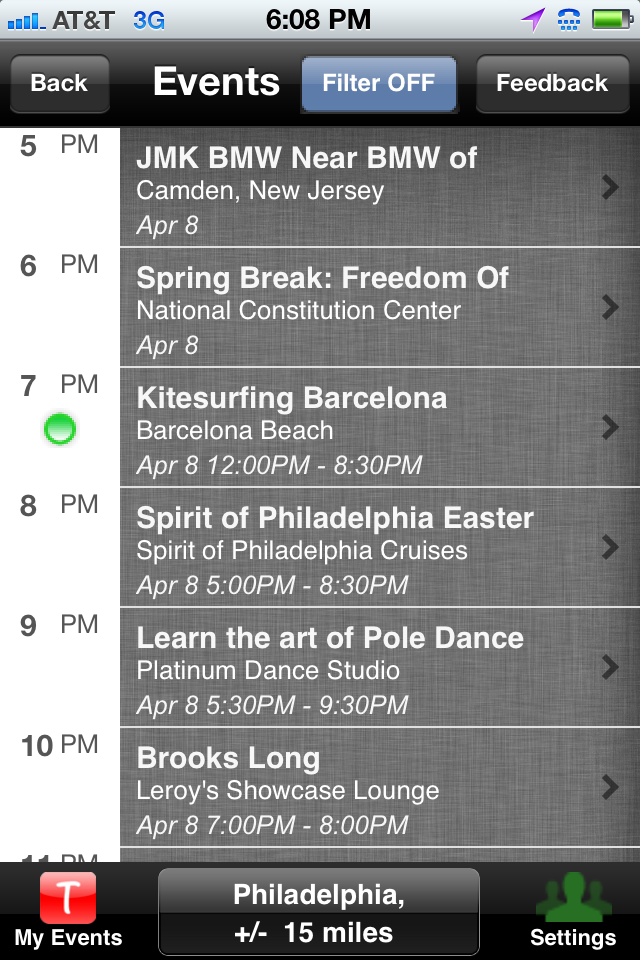
If you are looking for something fun to do in your current vicinity and you are out and about, at work, or sitting in front of the TV, try the TimetoEnjoy application on your iPhone or iPad. The app seems to be geared to the 20 to 35 crowd, but has lots of suggestions around sports, theater, music, movies, entertainment, product demonstrations, cruises, classes, exhibits, tours. Basically a variety of activities that people are going to be interested in.


The site allows the viewer to look at activities on a certain day and time in a city. The interface is clean and simple. Clicking on the event allows the user to see a description, find directions, purchase tickets, and learn more via Google. The viewer can put the event in a calendar or communicate the event to friends. It allows the viewer to send these activity listings to friends via email, SMS, Facebook, and Twitter. The database for the activities comes from Eventful.

The app could be improved by offering more option for families with kids as they are always looking for something to do. There are filters which allow the user to avoid categories of activities in their search. Later versions of the application will have a learning function like Amazon and provide suggestions. These types of recommendations would be good for alerts. The positive aspect about a suggestion engine is that it tailors events to the viewer’s tastes; the bad part is that viewer may want to try something new that he/she had not had a previous interest in.

As it is now, the application is good for answering the common question, what do we do tonight? And getting an answer that will allow you to enjoy your time. For that reasons it is worth having on your phone.

Thursday, March 29, 2012

Banking Services for the Under Banked


The under banked are not a traditionally a good target for banks. They do not typically have large bank accounts for the banks to make money off of savings accounts. They typically do not have large incomes to support high value loans. They may also not be a good credit risk for the bank’s credit card business. But wireless carrier economics are different. Carriers can leverage a service that nominally increases a customer's charge over a large customer base to increase revenues substantially. Carriers also are looking for services that reduces churn, especially for prepaid customers where churn is high. Banking services create stickiness as people tend to have long relationships with their financial institution. Prepaid wireless carriers are in a position to offer banking services to the under banked population as there is a high correlation between prepaid customers and the unbanked.

Making a Solution Possible

A company Vesta (www.trustvesta.com) has been in the prepaid top up business for years offering a turnkey prepaid top up solutions for a number of carriers around the world including Verizon, AT&T, Boost, Telcel, China Mobile, Vodafone and Telefonica. Vesta is offering a new turn- key financial solution that allows customers to pay their bills and make electronic payments. The customer puts money into a mobile wallet account run by the carrier, Vesta, and a program manager like Fiserv for example. These funds can come from a Green Dot Card, a prepaid card from Visa, MasterCard or others, cash at a retail store, or via direct deposit. The customer is charged $3 for inputting cash into the mobile wallet account. The customer is given an application on their smartphone which they can use to pay bills or transfer money from the phone; and a card which they can use like any prepaid card. The carrier, Vesta and the program manager share in the transaction fee from the merchant or electronic bill pay. The program manager is an accredited financial institution, takes care of the storage of funds, and makes money off of the float.


What has really changed the equation and made this opportunity possible is smartphones, which are getting cheaper and growing in popularity with prepaid customers; along with application stores and easy downloads. A small computer and usable applications are in the hands of people who did not have this access before.


Vesta Smartphone Application

Benefits to the Customer

The benefits to the customer are the convenience of electronic bill payment, electronic money transferring, lower cost money remittance (Vesta works with various money remittance companies in various parts of the world), as well as and maybe more importantly, a good record of income and spending.

Limitation and Potential Opportunities

Currently this is only being offered on Android phones 2.2 and 2.3, and will be offered on the 4.0 Ice Cream Sandwich version of Android 30 days after launch. Android is where the main intersection of smartphones users and prepaid users exist.

At this point in time, creating interest bearing is a small factor because the rates are low. But this could be a good way for people feel good about this service. The unbanked do not typically get interest on their money and would see this as being very attractive especially as interest rates go up.

Other opportunities in the space include:

• Cash back on purchase like PerkStreet Financial (www.perkstreet.com) offers. People in the under banked group will see that as a highly attractive feature.
• Tax preparation with automatic rebates: The under banked typically have simple returns that can be done by imputing the W-2 by the camera on a smartphone. The carrier can advise clients on how to save money on taxes via an easy to use application.
• Offering discounted coupons to merchant stores.


Win Win Scenario

This is a service which will be most attractive to carriers that focus on prepaid services in the US and international carriers everywhere else because of their high % of prepaid customers. This service is not a standard telecom service so carriers will have to promote and put their trusted brand name behind this product. The service has the hallmarks of a good product in that economically it adds revenues for carriers with the additional benefits of increased loyalty. For customer’s it saves time, creates more control around their finances, and offers potential cost savings. This can be a win-win for both parties, the hallmark of any good business transaction.

Monday, March 19, 2012

Geo Social: No longer at a loss for words

Geo Social is now starting to become mainstream. Many companies are popping up to allow people to make connections with who they know in their town (www.foound.com) and when they travel (www.ajungo.com). This is due primarily to three main factors: the penetration of smartphones to the mass market so the majority of the people in the market have a geo-sensing device that provides a rich experience; the overall popularity of Facebook so that many people with smartphones can be connected; and the ability of linking to Facebook to applications thus having readymade content at any application developers disposal.

Geo Social will take the next step in allowing people to know each other in the room via a wireless network connection and a social networking connection. This capability will probably be used in certain situations like business conferences and in dating situations where people do not know each other and will want to make some type of connection. This will move Geo Social from a community communications tool to a personal identifier and information source.

Geo Social will perform the function of knowing people's interests and characteristics before you actually meet them. It will a good conversation starter in a business situation when people are looking to make small talk and build a bond, in a dating situation where it is always more interesting to talk about something in common, or simply a way for people to exchange ideas about a topic they are passionate about. This evolution of making social interaction more efficient started with Facebook and will continue with geo social because it has value in creating more efficient conversation and it makes people more comfortable as they are able break the ice and start a meaningful conversation.

Privacy concerns do exist, and they become more impactful because the geo targeted person is at a physical location. Geo Social connecting needs to done in certain situation and should be turned off when the person leaves the particular area. In addition the same rules apply in providing content on social networks in terms of how you want to be perceived and known about. This may differ depending on the situation. LinkedIn for business situations and Facebook for social situations. People do in fact have different personas in different situations.

Some small companies are working on these types of solutions, but the larger social networks like Facebook and LinkedIn can use this to understand how people connect based on location, who people are interested in connecting with in a face to face meeting, and what common interests’ people have. Geo Social makes social networking more valuable to the user and provides a way to provide more targeted and higher CPA advertisements simply because it can help start a conversation.

Friday, March 2, 2012

Mobile Devices from Investors and Innovators Viewpoints

Connolly Bove Lodge & Hutz, a nationwide law firm which specializes in corporate development and intellectual property (www.cblh.com) put together a very informative mobile device forum which consisted of two panels on mobile device investment and mobile device innovation. The panels were made up of investors, executives from start ups, leaders from successful mobile applications companies, an IP executive from RIM. The panelists included:

Bob Moul, Philly Startup Leaders, President
Philip Moyer, Safeguard Scientific, Technology Group Managing Director
Saul Richter, Emerald Stage 2 Ventures, Managing Partner
Chuck Sacco, Mobile Monday Mid-Atlantic, President
Jonathan Darcy, RIM, Director of Licensing
Scott Snyder, Ph.D., Mobiquity, President, Chief Strategy Office and Co-Founder
Scott Wasserman, appRenaissance, Founder and President

The discussion revolved around what is shaping the mobile market, and where to put investment dollars and build businesses. The exchange of ideas took many interesting turns but revolved around the user experience, and the flood of data that comes from ubiquitous computing. The general takeaway is that companies need to fundamentally rethink the way they are interacting with customers, and be able to effectively manage and profit from the size and speed of data.

The two shoulders of tablet demographics will make tablets mainstream:

The panelist in the Investment Panel exposed the idea that there are three generations using electronics: the younger generation, the PC generation, and the older generation. The younger generation is likely to use a tablet for content creation and viewing, the PC generation feels most comfortable creating content on a PC, and the older generation which had not really taken to the PC is in love with the tablet. The tablet’s appeal for non-technical people is very strong and that group includes Doctors. One panelist stated that 70% of doctors use iPads.

The appeal of the tablet to younger generations and to people who were disinterested in the PC will also bleed over to the PC generation in different degrees. I believe the tablet will be a near universal device because of its ease of use, intimacy, universal application capability, and mobility. In the US we have a TV in every room, well in less than 10 years we will have a tablet in everyone’s hands.

There are still hurdles to overcome with the universal use of tablets. The same study from Spyglass Consulting Group that found 70% of Doctors own iPads stated that very few use them at their practice. One of the main reasons is that applications are not transferrable to the iPad. The full utilization of this tremendous user experience via mobile devices (Tablets and Smartphones) is being held back by the lack of integration to and responsiveness from mature backend systems and databases. These two worlds are going to have coalesce and the panelist believed standardization and efficiency between these two worlds needs to happen.


HTML 5 Tug of War:


The panelist brought up that there are two competing groups in the mobile space. One group is the browser based companies like Google, Facebook, and Amazon who are promoting the use of HTML 5 because it allows for the universality of service across devices and allows them to be the center of the user experience as they are in the PC world. One of the examples given was that the Kindle Fire is primarily a browser based device.

Then there are the device centric companies that introduce interfaces that make the device both more usable and more relevant. These newer interfaces and capabilities only work with the native application. Device companies need to continue to innovate and bring useful and enjoyable interfaces to the customer. One of the panelist believed that for the time being the device will be the most relevant piece of the consumer experience. This is certainly proving out in Apple’s explosive growth.

The carriers were discussed in passing do not have a major stake these ecosystems, which was a far cry from what the discussion may have been 5 years ago. The carriers are a pipe and the customer appeal characteristics have to do with quality of service, and customer service. However the carriers, I believe are more likely to support the device centric view of the world because it allows them product differentiation.

The panelist from the innovations panel believe that HTML 5 in its current state was good for brochure wear but companies that needed to provide a better user experience should look to native applications. As businesses evaluate different mobile options, it really depends how the company wants to engage with customers and the customer wants to engage with a company. Both HMTL 5 and native applications may be needed to engage the customer on their terms.

Big Data is a Game Changer:


To the panelist data is paramount trend and doing predictive analytics is an area that will highly impact business. The precision that some companies like Target can use information is astounding and in one case the panelist stated Target knew a girl was pregnant before her Father did. www.nytimes.com/2012/02/19/magazine/shopping-habits.htm?_r=1&scp=3&sq=Target%20Shopping&st=cse

This can provide tremendous marketing advantages. In addition the number of devices is growing and can throw off 200 or more indicators of the person’s interaction with the device and the user’s environment. The current need for data analytics to remain competitive, the explosion of the devices, and the capability of those devices are driving cloud economics. The current data flood has already outgrown existing database capabilities according to one panelist. We live in a world of high data capacity and traffic demands will only grow. Cisco predicts that by 2013 the annual traffic on the Internet will be 667 exabytes.

Cloud computing with its scalability of storage and processing power, and flexibility via virtualization are the back office systems of this century. The panelists believe that providing the connectors between the devices and cloud are a key area of opportunity. These connectors will allow legacy databases to react with devices users that are expecting instantaneous feedback.

Other key points on mobile devices:

Human Interaction:

Human interaction changes with mobile devices. This can lead to both better customer responsiveness in stores, and in our personal lives less direct personal interaction. One panelist stated that each generation must deal with the predominate technology of their generation.

We live in an App World:

The moderator for the Mobile Device Innovation panel stated that they choose a dog kennel company because they could watch their dog on their iPad while they were vacation. Use of a smartphone and tablet are clearly differentiators for business and this trend will only get stronger.

Privacy is lurking as a defining issue:

People do not have full control over the data that is being collected on them, and this data may impact their lives and how companies want to interact with you. One of the attendees brought up if people had control over their data, they might be able to use it for sale or barter. This is essentially what Facebook is doing via advertising, and users are getting community and engagement in return.

Is Social the new .Com?

One of the panelists brought up this point in reference to articles that question Facebook’s revenue capability. This point was in contrast to some member of the innovation panel that highlighted the value of Facebook in developing applications and the power that Facebook had in creating interest in applications. Clearly social networks have value. Monetizing that value is the challenge. Giving social network users the needed benefits will keep the personal information exchange open provided the user feels they have appropriate control of the information. The monetizing of social networks is likely to be around allowing businesses to foster better, more comprehensive and efficient relationships with their customers.

I wanted to thank Connolly Bove Lodge and Hutz LLP and the panelists for putting on this informative event. It gave a great overview of the mobile and data markets.

Friday, February 24, 2012

T-Mobile: Back to the Future with a Twist

T-Mobile announced its 4th quarter earnings and it plans to make adjustments after the AT&T merger failed. Needless to say they have their work cut out for them, but they did make some positive adjustments and will have to think creatively about how they are going to succeed without the iPhone.

T-Mobile did what they had to do on the network side:

They announced a plan to adopt LTE in the AWS bands in 2013 in order to be competitive with the other players in terms of throughput and customer experience. They will have 50% of the covered POPs with 20 MHz and will likely need more spectrum in the future. T-Mobile may benefit as they have in the past by rolling out technology late when the prices have come down and the technology is more efficient due to lessons learned or advancements.

T-Mobile is also shifting some of its HSPA+ capacity to its PCS spectrum to gain more international traffic. The company also plans to work with various worldwide alliances to offer attractive worldwide roaming plans to customers.

The good news about the break up was that T-Mobile is receiving a break- up fee from AT&T of which they are using part of for a $4 Billion to upgrade their networks. If they are able to hold their position and grow their business additional funding is likely to be required for network capacity and additional spectrum.

No iPhone Issues Still Exists

The iPhone continues to be a halo product which carriers can use to create excitement among customers. Despite its high price the iPhone has penetrated the mid- tier market which is T-Mobile’s bread and butter. One of the reasons T-Mobile has had flat to declining subscriber numbers in 2011 is that they do not have an iPhone. They will have to deal with this issue in creative ways. One of the ways is to promote the Windows 7/Nokia phone as an attractive alternative to the iPhone. This can be done via better integration with mobile web services and the phone for consumers, and better integration, control and faster application development using .Net for the enterprise. T-Mobile will need to be a primary distribution channel for Windows 7; and on the flip side Microsoft and Nokia need a supportive distribution outlet for their product in the US.

Still Squeezed in the Value Play:

T-Mobile is still squeezed between a rock and hard place in terms of value from companies like Metro PCS, Leap, and Tracfone who offering attractive deals which are often better than T-Mobile’s. On the higher end they face competition from companies like Verizon for better network coverage and all three of its larger competitors who have the iPhone. T-Mobile continues to offer service at a competitive rate and tries to out advertise its lower end competitors. They also provide value at the fringes for people whose iPhone contract has run out or to international carriers looking for better rates than AT&T.

Business Market is Needed but Not Gotten.

T-Mobile has always lagged the other carriers in enterprise adoption. T-Mobile competed by offering lower service charges and better customer relationships than their competitors. This focus on the business market was put on hold during the AT&T merger negotiations because of the service uncertainty and the need to continue to maintain a subscriber base as the merger approval process continued. It was a much more straight forward proposition to focus on their strength in the consumer market. T-Mobile has reinvigorated it enterprise effort by hiring 1,000 new sales people. T-Mobile success in this market will go hand in hand with convincing enterprises that the Window Phone 7 is a better enterprise choice than the iPhone.

Summary:

T-Mobile continues to be a patchwork of strategies in order to get revenues and stay afloat in the competitive US market. The good news is that T-Mobile still has a good reputation among consumers. They will make some network adjustments to remain competitive and gain additional revenues. If they can gain the iPhone then they will be in much better shape, but this is not likely to occur until they prove they have long- term staying power. That long term staying power is likely to depend on how efficiently they are able to rollout their network plans and how capable they are in promoting the Windows/Nokia phone as a strong alternative to the iPhone.

Thursday, January 19, 2012

Antennas are a key part of the LTE Transformation

One of the major themes of CES 2012 was the rollout of LTE handsets:

• Verizon announced three new devices the Motorola Droid 4, Droid Razr Maxx and LG Spectrum, a mini-tablet and a pair of mobile hotspots that run on the their network which covers 200 million POPs (Covered Population).

• AT&T announced 7 new devices and a tablet including the Nokia Lumia 900 and the HTC Titan II, the first Windows Mobile OS LTE devices, and a number of Samsung LTE devices with the Android operating system.

• Sprint announced it will have the Samsung Galaxy Nexus smartphone and the LG Viper running on their LTE network they plan to rollout later this year. Sprint and Clearwire’s move to LTE has effectively ended WiMAX as a major wireless technology.

LTE in 2012 will become a major wireless technology in the US. This driven by Verizon’s need for a faster, more cost effective broadband solution, and the need for the other player to match Verizon’s service and to use a technology that will be the worldwide standard. But the rest of the world is not moving as fast as the US. What is going to help make LTE grow as a technology that is adopted around the world?

Certainly, less expense handsets, and more carrier network rollouts in other regions of the world. The US carriers are doing their part to bring down the cost of LTE handsets by creating volume. However, most of these handsets only work in a limited frequency range and thus only work on the carrier’s network and in country. In fact a consumer needs to buy a new LTE phone if they move from Verizon to AT&T and vice versa due to the different frequency capabilities of the phone and the difference frequencies the network operators run LTE on.

A couple of antenna manufacturers, SkyCross and Ethertronics have developed antenna solutions that allow for multi frequency LTE device usage:

• At CES SkyCross announced its VersiTune-LTE tunable antenna module which supports up to 12 frequency bands and optimizes MIMO (Multi input multi output).

• In 2011 Ethertronics announced its EtherSmart LTE 1.0 product line which allows for tuning across 13+ frequency bands.

Not all frequency bands are going to be used in a single device and will be subject to carrier discretion in terms of what frequencies their networks run on, who their roaming partners are and what are relevant regional frequencies for LTE. But these capabilities open up the possibility for global roaming with LTE and provide:

• An incentive for operators to invest in LTE networks in their home country to gain roaming revenues.

• A solution for operators to work together to provide worldwide service packages like Verizon and Vodafone.

• A desire for business people and consumers to push for LTE services which run faster than existing networks.

• A desire of countries to upgrade their services so they are not seen as technologically behind.

Antennas are one step in the solution, the chip makers like Qualcomm need to provide multi frequency LTE capabilities on their chips sets but this is more of an evolution if the market incentives are in place to make this happen. The antenna solutions have started the ball rolling in what can be a true ubiquitous worldwide standard for wireless communication by the end of this decade. The implications of this will be profound on many levels.

Wednesday, December 21, 2011

Mobeam: What's it mean?

This week Mobeam, www.mobeam.com, announced a deal with P&G to provide the light beam transmissions from smartphones that can be read on the standard point of sale barcode laser scanners. This technology will allow for multiple coupons to be read at the point of sales instantaneously; allowing for control of coupon redemption; and the ability to know individual users, and the time and place of purchase. The coupons can come from scanned QR codes, mobile and internet web sites, or emails and other electronic messages. P&G can integrate this with their eSAVER.com web site and allow people to redeem coupons with their phones. It certainly puts more power back in the hands of brands and could potentially do this for retailers, or newspapers who want to offer coupon wallets on mobile phones.

According to Mobeam all of the major handset manufacturers are installing the Mobeam software into their phones as a way to make the phone more valuable to the consumer. They are doing this on all new smartphones starting in 2012 so the use of this capability will take a coupon of years to become a mainstream behavior.

Right now the company is focusing on low hanging fruit. According to the Mobeam press release the coupon market is a $3.7 Billion annual market with 300 million coupons scanned each year in North America. www.mobeam.com/uncategorized/mobeam-partners-with-procter-gamble-to-reinvent-the-coupon/

The other interesting aspect of this technology is that it can be used for ticket entrance into sports arenas and also be used for payments. This brings up the point of what will be the primary point of sale payment method for mobile phones. Will it be NFC, light transmission, magnetic strip readers (like Square), photo credit card scanners (like Jumio) or mobile web purchasing (like Paypal)? It is really going to depend on:

• Ease of use
• Security
• The existing cost to upgrade existing equipment

Clearly the technology which gets a strong foothold in the market will have a momentum advantage.

My prediction is that we will see a variety of these different technologies in handsets and working on different applications depending on: the payment, redemption or access situation; the need for secure access; and the need to upgrade existing POS or access equipment

There are many different air interface technologies like Wi-Fi, Bluetooth, and ZigBee. Each has some overlap, but serves different applications and devices better. This is likely to the case for payment, access and redemption capabilities on a handset. However, the gating factor in adoption will be how easy it is for consumers to use.

Wednesday, December 7, 2011

Social Mobile Media

A couple of weeks ago I went to the Social Media Plus conference in Philadelphia. www.socialmediaplus.com. It was an excellent conference which covered a lot of material from Facebook to search engine optimization, how businesses can utilize social media, and it had a number of case studies which highlighted business applications. Some of the ways social media is being used by businesses include:

Brand Marketing: The social media channels are where the eyeballs are, especially young eyeballs. Facebook is the leader with 800 million Facebook users and Twitter has over 250 million messages per day. Social media is where brands are both displayed and talked about. For some companies the Facebook page is like another web page.

Public Relations: Social media is used to highlight the benefits of brands and companies as well as protect brand and company image. The speed at which information flows over social media makes it a requirement to spread positive news and to react quickly and accurately to negative news.

Customer Interaction: Social Media is a two- way street where customer expect to interact with companies to deal with product issues, and to talk about the benefits and drawbacks of products. People use social media to follow and share the content they care about. Companies can use this interaction to build support from users who will be advocates of the company via social media or word of month. In addition, companies can use social media to broadcast solutions for product issues as well as learn about how people are using or want to use products.

Drive Leads and Sales: This is often a more subtle art and science proposition than interacting with customers and it requires planning, monitoring and execution. It is going to require understanding the people the company is advertising to on social media, creating a community of trusted people who are ready to accept your message, understanding the social media is interactive multichannel forum that needs to be measured; and moving people through a purchase funnel with social media, search and a good landing page.

Employment Acquisition and Dismissal: Many companies, by some counts 80% of large companies, use LinkedIn to find prospective workers. Other companies monitor social media sites when deciding who to hire. Companies will also fire employees for what they say on social media so an employee social media policy needs to be in place.

What does this mean for mobile?

There are a large number of mobile users with smartphone who access all types of social media. It is estimated that 350 million people use Facebook on their mobile device. Mobile search traffic is generally much smaller that PC traffic so it may not be a strong candidate for search engine optimization, but this will depend on the business. However, mobile traffic is growing and it has a number of implications:

Mobile Increases Reach: Mobile allows more people in developing countries and in lower economic demographics of society to have access to social networking. Mobile is also the Internet device of choice for younger demographics. This can have and already has an effect on the political process and how candidates are viewed. It is not inconceivable that someday people can vote via their Facebook page just like they click a like button. In addition, brands and companies can reach out to more people that they have not had communications with before.

Mobile Blurs the Line Between On and Off Work: Often people act more impulsively when they communicate with a mobile phone or forget they are representing the company when they are away from work. Often the way people communicate when they are away from work is with a mobile phone. Companies need to be careful to inform employees that the Internet on the mobile phone is the same Internet on the PC.

The Mobile Phone is a Camera with Instant Upload: The phone can be used to take pictures that can put a company in a bad light and these can be quickly uploaded to social media where they can move very quickly across the Internet. This requires companies to monitor and have a plan in place to deal with negative issues that arise from broadcasting on social media.

Mobile is a Local Search Channel: 20% of Google searches are local and 40% of those are on a mobile phone. People use the mobile phone to find business locations, look up ratings, see what their friends liked or recommended. It is important that brands review various social sites to judge ratings and make adjustments or comments. In addition, companies need to make an evaluation to determine if social shopping sites like Foursquare can help them. Lastly and probably most important companies need to have a mobile landing page that is easy to use and gives customers the information and communication channel they need.

Mobile is used for instantaneous information retrieval and communication or when a PC or Tablet is not available: The phone is often used in place of a PC if a small amount of information is required or if a PC is not available especially in a search context. People also use a mobile phone for quick communications like that on Twitter and SMS. It is important that companies have a good search engine optimization and a mobile landing page so they can effectively funnel traffic into a sale.

Both social media and mobile are fast becoming fabrics of our interactions and daily lives. Companies need to understand and use social media and mobile to create the best selling and communication environments for their customers.

Monday, November 7, 2011

Mobile Payment Requirements

As ISIS stumbles to find its way in terms of bringing NFC chips to market and how it can derive revenues in the mobile payment space, as Google has an uphill battle installing NFC chips in phones and in getting merchants to adopt NFC point of sale terminals. A number of alternatives for in store payments have come to market or are being tested. They include:

• PayPal’s X.Commerce solution where a customer can pay in the store with a PayPal account.

• Square’s “say your name” to complete your purchase on an iPhone.

• Mobeam’s (www.mobeam.com) light based communication (LBC) which allows barcode readers to read many coupon stored on the phone. This is currently being proposed for coupon reading, but could be used for mobile payments.

• Modivmedia's (www.modivmedia.com) easy pass payment solution used in Stop & Shop stores.

NFC has lots of competition. The ability to pay with a mobile device is a nice to have and not a need to have. If it were a need to have Mastercard’s PayPass would be used by more people. It is not the payment solution that makes or breaks payments on a mobile phone. It is the mobile phone shopping solution that brings increased value to the merchants and the shopper.

A successful mobile payment solution will be one that allows shoppers:

• To feel secure using
• To get through the stores aisles and purchasing line more quickly
• To get discounts on desired items
• To easily use

A successful mobile payment solution will be one that allows merchants:

• To gain an uplift in brick and mortar sales
• To bring more customers into the store
• The ability to let customers shop as they want (Online,in store or both)
• To create a better customer experience and brand affinity
• To save on labor costs
• To reduce fraud
• To maintain control of purchasing and customer information
• To gain analytics on Internet and in store purchasing

There are many players who have entered the mobile payments ecosystem. All have some of the categories listed in the requirements for a successful mobile payments solution. As mobile payment solutions try to jockey for merchants’ and shoppers’ hearts, minds and wallets it is important to provide a solution that fulfills these requirements. Because at the end of the day, most customers have a credit card, debit card or cash they can use to make a purchase.

Thursday, October 20, 2011

CTIA Fall 2011: Enterprise Transformation

CTIA Fall 2011 was about how consumer applications, devices and services are meeting up with the enterprise and how the enterprise should plan and react. This can be seen from a number of different viewpoints. Consumer devices flowing into the enterprise and needing to be managed based on enterprise criteria. Enterprises reaching out and interacting with customers via their mobile phones and devices in a B to C arrangement. The mobile revolution that Steve Jobs created with the iPhone has now reached important levels inside enterprises. Decisions need to be made and solutions created that will allow enterprises to work in this environment and also be able to communicate and transact with customers effectively whether they by other businesses or consumers.

Enterprises adapting to the multi device environment

Vendors provided solutions for security and device management and capabilities for smartphones to improve productivity.

The EMF (Enterprise Mobility Foundation) (theemf.org) had a boot camp which laid out the basics and the primary issues of the enterprise mobility as well as gave real world examples of how that transition actually takes place. Much of this revolved around keeping data secure so that employees could take advantage of mobility on smartphones and tablets.

Device Management

Nukona (www.nukona.com) discussed an apps based security system that in effect puts wrappers around applications so that they work in conjunction with enterprise policy. This in effect makes that communications between the device and behind the firewall secure and allows for employees to have personal applications on the phone. It also allows enterprises to adopt any smartphone, to manage the data on the phones effectively and deal with other issues like personal data, and lost and stolen phones or tablets.

SOTI.net (www.soti.net) also showed its MobiControl device management case study with American Airlines and the capability of the system to handle a wide variety of devices.

Video Conferencing and Distribution

Polycom (www.polycom.com) made a big demonstration of its HD quality video conferencing solution, RealPresence. It works on several tablets including iPad2, Motorola Xoom and Samsung Galaxy Tab 10.1.

Enterprises also are using video more in a mobile environment with smartphones and tablets. QUMU which was recently acquired by Rimage Corporation demonstrated its enterprise video optimization, security and distribution system. www.qumu.com


Enterprises Interacting with its Customers

There were a number of solutions providers that used the various capabilities of the smartphone and tablet to increase business efficiency or promote products.

Camera

The camera of the smartphone is becoming an important business tool. Mitek Systems (www.miteksystems.com) is using the camera to allow customers to deposit checks with their cellphone, and pay their bills by taking a picture of the bill. In addition, it is allowing insurance companies the ability to give quotes by taking a picture of a driver's license and an insurance bill. All of these solutions are saving people and companies time and money.

Jumio Netswipe Mobile is allowing the smartphone to be a secure credit card reader allowing for additional security via card in possession authentication. This allows for transfer of funds without an external device attachment like Square has. www.jumio.com

Scan Buy (www.scanbuy.com) is using the camera to scan bar codes which can then be sent to Facebook pages and Twitter messages to distribute content or coupons. The company has seen a 1,600% growth since 2010 in the amount of barcodes scanned by phones. The beauty of the Scan Buy solution is that is able to track the devices, carriers, movement of the barcode to twitter and Facebook, and redemption of coupons or activation of content which originated from a barcode. The analytics captured by smartphones are going to become increasingly important as more phones are used to make purchases. This is also evident in Neustar’s (www.neustar.com) purchase of TARGUSinfo. Neustar’s product lines include short code/barcode management services

Geo-fencing

Geo-fencing is not only being used to find people’s location it is being used to bring people together with products they enjoy. Hipcricket (www.hipcricket.com), recently purchased by Augme (www.augme.com) a mobile site development company, has a geofencing solution that allows customers to who like Blue Moon Beer to know where in an airport they can get Blue Moon on draft.


Call Intercept and Data Capability


Nuance (www.nuance.com) offers a call intercept solution that allows carriers and enterprises to change a phone call into an online experience, allowing customers to find information to commonly asked questions like account balances, or recent purchases, and to text or message customer service people. It is a lot more pleasing that dealing with an IVR system and the enterprise can save on IVR costs.

Messaging

Mogreet (www.mogreet.com) took care of the messaging for the CTIA show but also talked about its solutions that allow radio broadcasters and other new media to extend their reach to a mobile phone. This included offering breaking news and multimedia content, song delivery, multimedia video advertising, contests and sweepstakes, daily deals and coupons and important analytics to track these activities.


Payments

Physical payments with a phone at a retail environment are still waiting to become mainstream and most of M-Commerce is on mobile web sites which make these sites vitally important. There were also examples of using iPod touches to speed registration at sporting events by Active Network (www.activenetwork.com). Next iterations will include doing this self service style on a smartphone. Active Networks also demonstrated a good solution for information and organization of events via a smartphone for very large events like Cisco Live to smaller chaotic events like swim meets.

Gemalto (www.gemalto.com) showed with a rail pass demo that NFC is not going to be just about payments but about permission with a transit train demonstration. The standardization of NFC will help bring down the costs of implementing entry permission systems as well as give better customer service like alerting companies if there is a problem or giving advice to transit card holders about train and bus arrivals, and delays.

Pay with cell phone also got some traction from PaymentOne (www.paymentone.com) and Charge Anywhere (www.chargeanywhere.com). PaymentOne charges payment for digital products to the carrier cell phone bill and introduced the ability for customer to view their purchase history. Charge Anywhere offers a Square like payment system that allows smaller merchants to use the cellphone and a card reader to take payments. Both of these products use the cell phone to facilitate commerce.

Wednesday, October 5, 2011

iPhone 4S, Keeping the iPhone Relevant

The iPhone 4S wasn’t so much of an evolution as an improvement in select features. The timing was not right to introduce technology features such as LTE and NFC. The LTE technology had to be more mature in terms of longer battery life and lower price per chip to be incorporated in the iPhone. For NFC, Apple had not garnered enough merchant support around a payments solution to create a fulfilling customer experience. Both of these technologies are likely to be in the iPhone 5, which will be more of an evolution to the iPhone product.

Still, the iPhone 4S made some good improvements. The better camera will certainly be appreciated by iPhone users. For many iPhone users the iPhone is their de-facto camera. The Cards iOS application is also a good feature and combined with the new camera features will provide value to the customer. There is something special about receiving a beautiful card in the mail. USPS had been offering this service on its web site for over a year. This is another example of Apple genius, taking an existing service and making it more user friendly and relevant.

Siri, the new voice recognition service is an interesting improvement. Voice recognition has always been a holy grail for mobile phones because of the size of the keyboard, and the perceived ease of use it would bring. But it has never reached its full potential, due to limited applications, and the mini keyboard being the preferred way to communicate. Here comes Apple, the company that changed the model for digital music, the smartphone and effectively created a market for the consumer tablet, with its implementation of voice recognition. Apple’s specialty is making technology come to life. From what I have read, it is fun, which is always popular with iPhone users and smartphone users in general. Many smartphone users consider their smartphone to be a close companion, and look to their smartphone to be entertained.

Apple also emphasized the iCloud service, which is an important evolution in the multi-device world. People need access to their information on various devices and they need reliable storage for devices like the smartphone and tablet because they are being used so much and are an important part of our personal and business lives.

“Find my Friends” iOS application that Apple plans to introduce will be a nice service but limited because it only works with iPhones and iPads. This highlights Apple’s somewhat myopic vision on interoperability. “If you are not an Apple user who cares” is not recipe for success in the communications world where interoperability rules.

Lastly, the introduction will help Sprint get their customers excited about buying an iPhone. Because at the end of the day, for Apple it is about providing an excellent customer experience and selling devices.

Friday, September 30, 2011

Greetings From 4G Americas

Included are some to the finding at 4G Americas, a show of GSM/HSPA/LTE service providers, device manufacturers, and infrastructure providers. Some of these finding we already know as one off results, others hit you in the face and say wow! that is impactful.


Spectrum continues to be a main issue:

The US has 1.5 MHz per subscriber. This ranges from 3 to 6 times less than many other countries. Yet data traffic in the US is growing very fast. We will need additional spectrum to keep up with data demand. The growth of data traffic is growing 10 times faster than voice traffic today. The 2010 total global mobile data traffic is 3 times the size of all global Internet traffic in 2000.

At T-Mobile: 4G (HSPA+) users average over a 1 GB/Month, compared with about 300 MB/Month with 3G. Video represents about 45% of data traffic on phones, Audio another 15%. This traffic pattern shift is causing the increased data usage.

Wi-Fi is becoming more important as a way to off load traffic:

It is not perfect especially in very crowded venues, but it allows customers to enjoy broadband data services without cost overruns on tiered data plans. In some younger demographic groups Wi-Fi data usage is over 50% of total data usage on a smartphone.

NFC is starting to solidify its position:

Part of the dilemma of NFC is getting NFC chips and the secure element into the phone. Carriers are committed through ISIS to provide the secure element, and charging a rent for it.


Connected devices are growing and future proofing is a key consideration:


The connected device market is growing quickly. AT&T has added 10 million connected devices in the past three years. Users of connected devices want to future proof their devices to avoid obsolesce or upgrade if a faster speed is needed. HSPA+ modems are only about $5 to $7 more expensive than 2G type modules.

Different spectrum frequencies for LTE prevent near term global roaming on LTE

The frequencies on which LTE runs in different countries span so many ranges that it will be hard to harmonize for LTE; HSPA+ will continue to be the global roaming standard for the foreseeable future.

Backhaul remains essential

Backhaul continues to be a large cost and bandwidth consideration. Many operators are moving over to fiber backhaul to keep up with the bandwidth requirements. Much of the data rush has taken operators in Latin America by surprise.

Latin American continues to offer opportunity especially for wireless data

Latin America has almost twice the number of subscribers as the US, but ARPU is less than a third of the US wireless spending. Data is growing quickly in Latin America, and Blackberries are still very popular. Spectrum is a key consideration for growth of data services. Many countries have not allocated spectrum for LTE.

Tuesday, September 20, 2011

Another Example of Our Move to a Cashless Society

We are living in an almost cashless society. We saw a lot of news and hype around this week around the Goggle Wallet, which is a good start but far too limiting in the amount of phones that can offer this service. The Google Wallet service also needs more merchant and brand support to make a mainstream impact.

How does functionality get imbedded into mainstream phones?

It has traditionally been with attachments like a camera or a QWERTY keypad hooked into a phone. These capabilities get popular and are then embedded in the phone to increase the phone attractiveness. Well, there is another example of an attachment that is gaining popularity, the Square mobile payment attachment which is on sale at Best Buy for $9.99. It has risen in popularity among college students who primarily use credit or debit cards. They use it when they want to transfer money to share costs. They do not carry cash so they split the bill using a credit or debit card. This functionality adds value because it ensures the college student gets paid, which is very important when money is tight. Having this capability imbedded in a phone will make phones more popular among the teenagers and 20’s age group. These are a primary group of smartphone purchasers.

If it is valuable enough for one group and there is a low barrier to using the service, other groups will find a way to adopt it if there is value, like Facebook. Peer to peer transactional changes are occurring because we are moving to a cashless society, and the phone can make these transactions easier. My grocery store clerk tells me 90% of all of her grocery transactions are with a credit or debit card. The phone will win out as the primary payment device because of its flexibility in making and receiving payments, ability to record transactions and control payments, and the capability to incentivize shoppers via personalized coupons.

Tuesday, August 16, 2011

Google Motorola Deal, Protecting Google’s Future

Google is about advertising and influencing the purchasing process. This is where their value is and where they create their revenues. Android is and will be critical in advertising and purchasing decisions considering the smartphones increased importance in the retail environment and the growth of m-commerce. First and foremost this deal was about patent protection, protection of Android and protection of future revenues.

Google was facing pressures from Microsoft who were exacting a tax on their Android partners for Microsoft patents, charging HTC $5 per Android handset and possibly charging Samsung as much as $15 per Android handset. Google needed the patents to handle these and other patent infringement issues that have come up in Europe, as well as future patent infringement issues.

Google has to manage the Motorola relationship with a hand off approach and sell the manufacturing capabilities if it creates conflict with its other Android partners. In the end Google wants to promote overall adoption of Android to promote its position in search, advertising and purchasing.

Google wants to be a major part of the customer’s purchasing process and has all of the pieces: Google Deals, Google Places, Google + and Google Wallet. All of these are not major players in their perspective areas, but put together with support of discounts to create loyalty and a good user experience, these services can create a strong consumer pull. Google Wallet is an important component of this strategy. Having an OEM to install NFC chips and Google Wallet will give the company the distribution relationships to create momentum in the market. The Nexus handset and only one carrier’s support (Sprint) is not likely enough to create momentum. With Motorola Google can try an end run around ISIS and also gain some international acceptance of Google Wallet in countries where carriers do not have as strong a distribution position as the US.

Much of Google’s future as the center of consumer buying experience on the smartphone is riding on Android and it had to protect its position in this very competitive smartphone market.